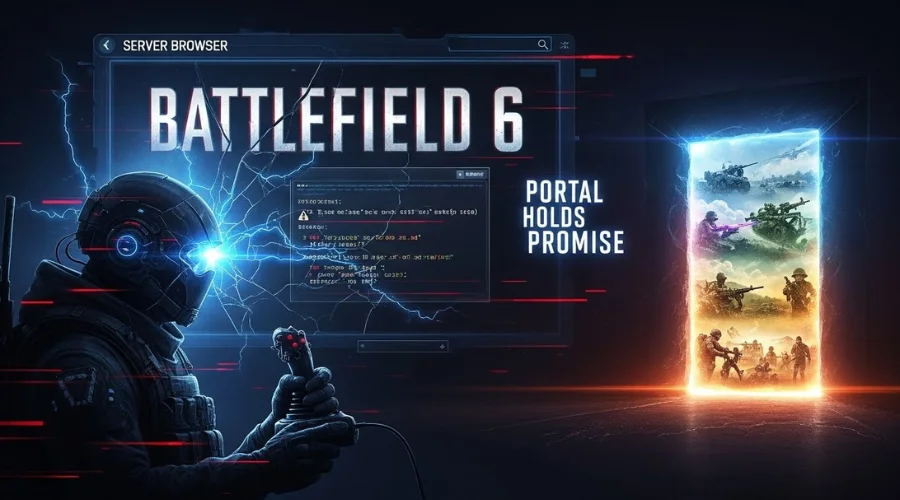
Since its launch, Battlefield 6 has sparked lively debates among fans and critics over its server-browser system. Many players have found the default browser unreliable, confusing, or downright dysfunctional. However, beneath the noise and frustration lies a growing sandbox: Portal a mode where community-made servers, custom maps, and creative gameplay have begun to flourish. This article explores why the traditional server browser is failing at its main job, what Portal does right, and how Battlefield 6 can strike a balance.
What Went Wrong with the Server Browser
1. Browser Limitations & Discoverability Issues
- The browser is described by many users as “clunky” and poorly laid out. Players struggle with minimal filtering options, slow searching, and inconsistent join behavior.
- Once you leave a lobby without saving or copying its details, it’s nearly impossible to find again. There’s no proper favorites or bookmark system in place.
- Custom games and community experiences quickly get buried under a flood of exploit or bot-run servers, making legitimate matches hard to discover.
2. Matchmaking-Only Servers Limit Player Choice
Unlike older games where players could pick exactly which server, map, or mode to join, Battlefield 6 uses a hybrid system: official servers are managed through matchmaking, not manual browsing. That means:
- No choice of server location or map rotation
- Squads are often broken up between matches
- Persistent communities and long-term server hosting become unfeasible
This design leaves many long-time fans missing the “classic” server-browser freedom.
3. Custom Lobby Management Is Broken
Even when players create their own custom servers, key functions like balancing teams, starting map votes, or moderating content are often non-functional or missing. As a result, custom servers rarely offer a stable, enjoyable experience, reducing the incentive for community-driven lobbies.
Why Portal Still Holds Real Potential
Despite these flaws, Portal is not written off by many players, and developers believe it could be the foundation for a lasting, creative community.
➡️Persistent, Community-Hosted Servers Are Now Possible
One of the biggest wins: Portal now supports persistent servers, meaning once you host or join, the server remains listed even after players leave. That makes custom game modes, modded maps, and long-term community servers viable again.
Along with that, the developers have expanded Portal’s editing tools: players can design maps, add new structures, and customize game logic. It’s a flexible sandbox reminiscent of classic modding or map-making communities.
➡️Verified Experiences & Balanced Content
The game’s team has committed to including verified servers in Portal’s listings, not just random, bot-heavy “XP-farm” lobbies. Verified servers aim to give full XP rewards, proper balancing, and a fair, stable experience.
That means Portal isn’t just for weird maps or experiments: it can offer serious, playable game modes that still feel like “real” Battlefield.
➡️Creative Freedom for Players
From recreating nostalgic maps to building entirely new scenarios (e.g., parkour arenas, custom vehicle mayhem, or even PvE-style fights), Portal allows players to express creativity. Users have already posted impressive custom levels and varied gameplay experiences, showing this mode isn’t just a gimmick.
What Still Needs Work: Portal’s Roadblocks
➡️Poor Discoverability & UI Mess
Despite being listed in the main menu, Portal’s access is often ignored; its design and user interface still make discovery difficult. Many players never find it or give up due to its confusing layout.
Filters don’t persist, favorite-server lists are missing, and sorting resets frequently meaning users must hunt through dozens of results just to find a decent match.
➡️Bot Farms and XP Exploitation
- At launch, Portal got flooded with “XP-farm” servers, lobbies full of bots meant only to grind experience. These dominated server lists, drowning out legitimate or creative servers.
- Even now, after updates aimed at nerfing those servers, many players feel the mode is still tainted by the bot-driven grind.
➡️Technical Limitations and Server Management Flaws
Players report bugs: revive-tracking issues, difficulty joining servers, or servers disappearing abruptly. Custom-server hosts often lack basic tools for moderation, team balancing, and map voting essentials for long-term community servers.
Beyond that, some custom servers run at lower tick-rates or reduced performance compared to official matchmaking servers, undermining quality for custom mode players.
How Battlefield 6 Can Improve Balancing Matchmaking and Community
Here’s what needs to be done to help bridge the gap between official servers and Portal’s community-driven promise:
➡️Add Proper Server-Browser Tools
- True server-listing with filters for map, mode, ping, player count, and region
- Favorites/bookmarking system so players can return easily
- Persistent servers for both custom and official playlists, similar to classic BF3/BF4
This would give players agency and restore the flexibility that many felt was lost.
➡️Promote Verified Community Modes
Give visibility to well-made community servers. A curated featured list could help separate good servers from the spam and bot farms.
➡️Improve Server & UI Stability
Fix bugs like mismatched revives, disappearing lobbies, and cross-platform invisibility. Ensure reliable server performance and smooth UX so players aren’t deterred by technical frustration.
What This Means for Players: Should You Dive Into Portal?
If you enjoy experimentation, creativity, and variety more than strict competitive balance, yes, Portal is worth trying. You may discover unique maps, custom game modes, or even build your own server with friends.
However, if you prefer reliable progression, balanced gameplay, and stable performance, waiting until the server-browser tools mature may be wiser. For now, vanilla matchmaking remains the most dependable option.
Frequently Asked Questions (FAQs)
Conclusion
In Conclusion, while Battlefield 6’s official server browser struggles, Portal is steadily evolving into a meaningful, community-driven sandbox. What once felt like a clutter of XP farms and empty servers is becoming a space for creative modes, persistent servers, and polished, verified content. However, for Portal to truly fill the gap left by the classic server browser, it still needs better discoverability, stronger stability, and improved server management. Until then, Battlefield 6 remains caught between traditional shooter roots and an experimental future with its direction ultimately shaped by both the community and the developers.