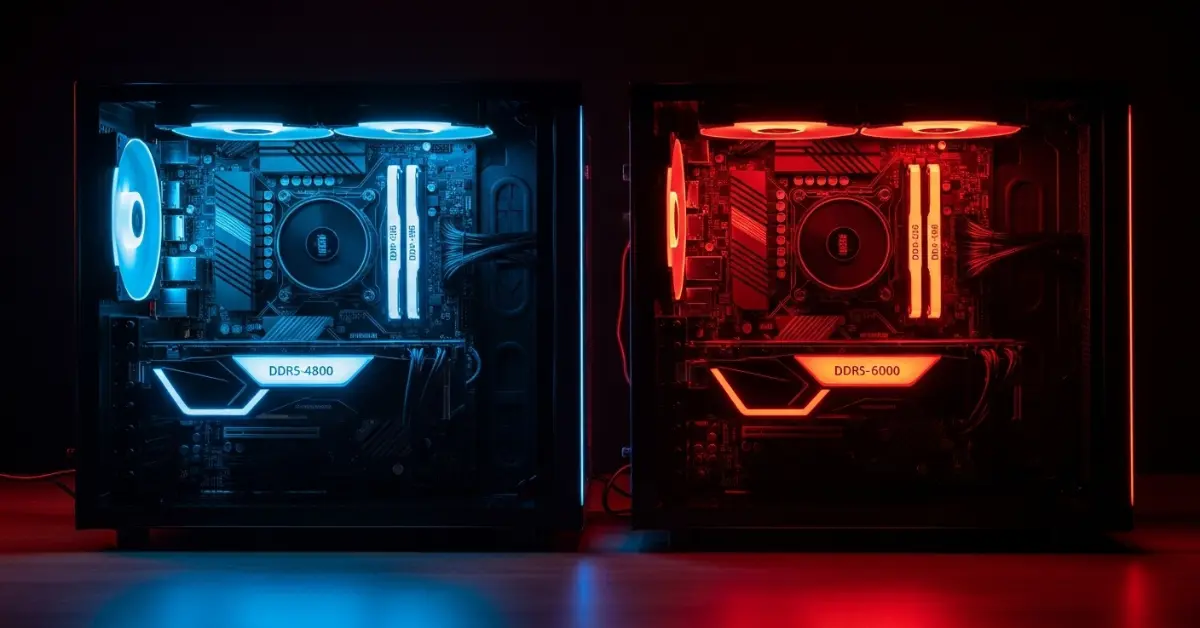
As DDR5 memory becomes the norm in modern PCs, questions continue to swirl about how much memory speed actually matters — especially for gaming. With DDR5 modules available across a wide spectrum of frequencies and price points, some users wonder if slower DDR5 RAM will noticeably impact their gaming experience.
This detailed exploration answers that question using real-world game benchmarks and performance testing. By examining how slow, mid-range, and high-speed DDR5 kits perform across a variety of titles, we reveal whether memory speed is a critical factor for gamers — or if its importance is often overstated.
Understanding DDR5 Memory and Gaming Performance
1. Why Memory Speed Matters
Memory speed (measured in MHz) influences how quickly data can be read from and written to RAM. Higher frequency and tighter timings can improve system responsiveness, particularly in tasks that involve frequent data access.
In gaming, memory interacts with the CPU and GPU to feed texture, physics, and gameplay data. But how much of a difference memory speed makes depends on the game engine and workload.
2. The Shift From DDR4 to DDR5
DDR5 improves upon DDR4 with higher base frequencies, improved bandwidth, and enhanced power efficiencies. However, DDR5 also introduced early teething issues like higher latency at certain speed tiers — leading to debates about whether faster DDR5 always means better gaming performance.
Testing Methodology
➡️Memory Configurations Compared
To evaluate the impact of memory speed on gaming, multiple DDR5 configurations were tested, including:
- Slow DDR5 (e.g., 4800–5200 MHz)
- Mid-range DDR5 (e.g., 5600–6000 MHz)
- Fast DDR5 (e.g., 6400+ MHz)
Each configuration was tested on the same test system with identical CPU, GPU, storage, and drivers to isolate the effect of memory speed.
➡️Game Selection Criteria
A wide range of games was chosen to cover diverse engine types and workload patterns, including:
- Competitive shooters
- Open-world RPGs
- Simulation and strategy titles
- CPU-intensive environments
This ensures the insights reflect realistic user scenarios rather than synthetic benchmarks alone.
➡️Performance Metrics Recorded
Key performance indicators included:
- Average FPS (Frames Per Second)
- 1% low FPS (indicating smoothness under load)
- CPU and GPU utilization
- Memory bandwidth usage
These metrics help determine both overall performance and stability under varied memory speeds.
Benchmark Results Competitive Shooters
Case Study: Arena Shooter
In games where rapid movement, precise hit detection, and low latency matter (e.g., arena shooters), tests showed only modest performance differences between slow and fast DDR5 modules:
- Average performance remained similar across memory speeds
- 1% low FPS sometimes improved with faster memory, but gains were small (often single digits)
This suggests that in highly optimized, GPU-bound shooters, memory speed isn’t the limiting factor at typical gaming resolutions.
Open-World and CPU-Heavy Games
Case Study: Open-World RPGs
Games with expansive environments, large entity counts, and heavy CPU demands showed more noticeable differences:
- Faster memory offered measurable boosts in minimum frame rates
- Average FPS sometimes improved by up to ~5–7%
- Loading times for world assets and transitions also improved slightly
The result reveals that in CPU-bound or data-intensive parts of open worlds, memory speed becomes more relevant.
Simulation and Strategy Benchmarks
Case Study: Real-Time Strategy
Simulation and strategy titles that manage large maps, AI decision trees, and unit counts can be more sensitive to memory performance.
Here, results showed:
- Higher memory speeds helped reduce stutters
- CPU bottlenecks were less severe when paired with faster DDR5
- Large scene simulation tended to favor enhanced bandwidth
However, the performance delta was still smaller than in synthetic benchmarks — meaning that real-world gaming only benefitted modestly.
Why Memory Speed Isn’t Always a Game Changer
1. GPU Bottlenecks Often Dominate at Higher Resolutions
In many modern games, especially at 1440p or 4K, the GPU carries the performance burden. In these cases:
- Memory speed had minimal influence on FPS
- GPU utilization remained high regardless of RAM configuration
This suggests that for GPU-bound scenarios, upgrading the GPU offers more tangible gains than investing heavily in top-tier memory.
2. CPU Impact Depends on Game Engine Design
Some engines leverage memory bandwidth more intensively than others. For example:
- Titles with large open environments or frequent data swaps benefit more from faster memory
- Linear, GPU-driven games show less sensitivity to memory speed
Understanding the game engine helps set realistic expectations.
1% Low FPS and Smoothness
Minimum Frame Rates Matter
Gamers often focus on average FPS, but 1% low FPS provides insights into smoothness during intense scenes. Here’s what testing revealed:
- Faster DDR5 generally offered better minimum FPS
- The improvement wasn’t drastic, but notable in CPU-bound sections
- Smoothness gains help prevent microstutters and frame dips
This suggests that faster memory contributes more to consistency than outright peak performance.
Memory Bandwidth and Latency Explained
➡️Bandwidth Provides Headroom
Higher memory speeds increase bandwidth, which can feed CPU workloads more efficiently. This matters most in tasks where data is constantly streamed in and out of RAM.
➡️Latency Tradeoffs in DDR5
DDR5’s initial higher latency at certain speeds means that raw frequency isn’t the only factor — efficiency and timing matter too. In many cases, balanced DDR5 kits (mid-range speeds with optimized timings) deliver the best real-world mix of bandwidth and latency.
Practical Advice for Gamers
1. Choose Memory According to Use Case
- Competitive esports: Mid-range DDR5 offers excellent value with minimal performance loss.
- Open-world and simulation gamers: Faster DDR5 can yield modest gains, particularly in minimum frame rates and loading times.
- Creators and streamers: Faster DDR5 can help with workloads beyond gaming, including editing and large dataset processing.
2. Don’t Overspend on Memory Only
Investing in faster memory at the cost of a more powerful GPU often yields diminishing returns for gaming. GPU upgrades typically deliver greater performance impact.
3. Optimize Memory Profiles
Always enable XMP or EXPO profiles in BIOS to ensure memory runs at rated speeds. This ensures you get the most out of your purchase without manual tuning.
Real-World Observations and User Scenarios
➡️Casual vs. Hardcore Gamers
Budget gamers will be well served with mid-range DDR5, while enthusiasts who chase every possible frame might opt for higher-speed kits — but the performance gains need to justify the cost.
➡️Future Game Demands
As game engines evolve, memory demands may increase. Faster memory might offer greater longevity for future titles, but the current generation shows only modest dependency.
Frequently Asked Questions (FAQs)
Conclusion
The idea that memory speed alone will make or break your gaming experience is an oversimplification. Real-world benchmarks across a variety of games reveal that while faster DDR5 can boost consistency, minimum frame rates, and CPU-bound performance, the overall impact on average FPS is often modest — especially in GPU-bound scenarios.
For most gamers, mid-range DDR5 memory paired with a capable GPU and CPU offers the best balance of performance and value. Faster DDR5 still has its place, particularly in CPU-heavy titles and future-proofing setups, but it shouldn’t be viewed as a make-or-break component on its own.